
How to tell a broken spring from a broken opener in sixty seconds
We book the fix when the door is stuck half open, a spring snapped, or the opener clicks and nothing moves.
Text us and someone answers within two minutes, any hour. If you call, you hear a short greeting and get a text back.
Pull the red release cord hanging from the trolley and lift the door by hand. If it feels like dead weight and will not stay up on its own, a spring has gone and the opener was never the problem. If it lifts easily with one hand but the motor will not move it, or the motor runs and nothing happens, the opener side is where to look.
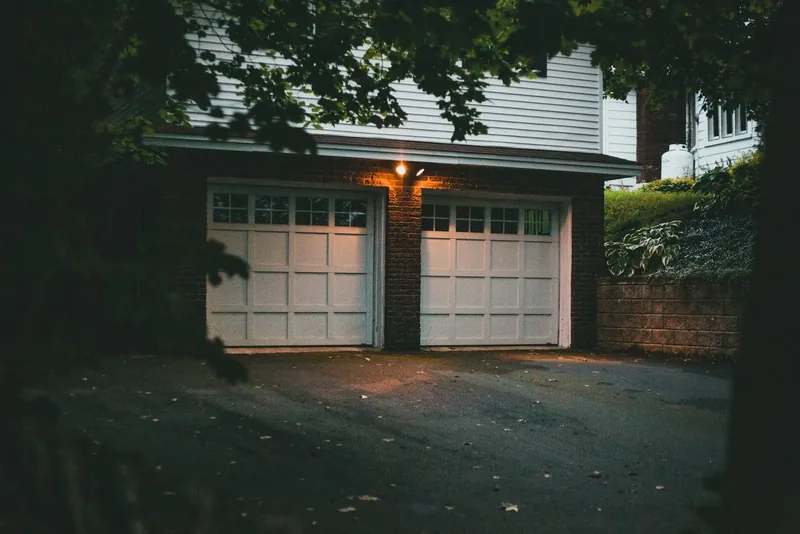
Why the two get confused from the driver's seat
Both failures end the same way: you press the button and the door does not open. A spring failure and an opener failure can even sound similar from inside the car, a click or a strain, nothing lifting. The difference is not in what you hear through the windshield. It is in what the door does the moment the motor stops being involved, which is why the one test below settles it faster than any amount of listening at the button. Most of the calls that come in as "the opener is broken" in Stamford, Norwalk, Greenwich, Darien and New Canaan turn out to be a spring problem wearing an opener's symptoms, because a healthy opener is built to move a balanced door, not to lift the door's full weight on its own.
The test: pull the cord and lift by hand
Every residential opener has a manual release, usually a red cord hanging down near the trolley rail in the middle of the ceiling track. Pulling it disconnects the door from the motor completely, so what happens next is the door and the springs only, with no opener in the picture at all.
With the door closed, pull the cord, then lift the bottom edge a foot or so and let go.
A door with working springs feels light, something close to ten pounds even on a full double door, and it stays roughly where you left it instead of dropping. That is the spring doing its job: it is supposed to counterbalance almost the entire weight of the door, so a healthy lift feels almost free.
A door with a broken spring feels like what it actually weighs, somewhere between 150 and 400 pounds on a two-car door, and it drops the instant you let go rather than holding position. If that is what you felt, stop here. The opener is not your problem; reconnect the trolley, leave the door down, and call about the spring.
If the door lifted easily and held its position, reconnect the opener and try the button again. Whatever is stopping it now is on the opener side: the motor, the sensors, the gearing or the circuit, not the springs.
The signs, side by side
The first five point to the spring. The last four point to the opener.
A bang loud enough to wake the house
A spring under tension lets go in a fraction of a second. People describe a gunshot, a dropped bowling ball, or something heavy falling off a shelf, usually with no warning beforehand.
The door is suddenly heavy by hand
This is the manual-release test above, and it is the single most reliable sign there is. Heavy and dropping means the spring, every time.
A visible gap in the coil above the door
A torsion spring sits as one tight coil on a shaft above the opening. A broken one shows a clear gap where it separated, with the two halves sprung apart from each other.
The opener lifts a few inches and gives up
This looks like an opener fault but is usually the opener correctly refusing to fight a door that has become too heavy for it. The motor is protecting itself, not failing on its own.
The door drops fast or comes up crooked on one side
On a door with two springs, one failing while the other holds leaves the door out of balance rather than simply stuck. It may lift unevenly, drop faster on the weak side, or bind in the track as it travels. This is also a spring symptom, not an opener or track fault, even though a crooked door looks like a track problem at first glance.
It clicks and nothing moves
A relay firing with no motion points at a stripped drive gear, a failed capacitor, or a logic board issue, assuming the manual-lift test already confirmed the door itself is light and balanced.
It hums and strains, but the door barely lifts
If you have already done the hand-lift test and the door was genuinely light, this is motor or gearing. If you have not done that test yet, do it before replacing anything, because this exact symptom is also what a spring problem looks like from the driver's seat.
The remote does nothing but the wall button still works
That split points at the remote or the receiver, not the motor or the drive. Worth saying out loud when you text us, because it changes what gets brought on the van.
It closes a few inches then reverses back up
Almost always the two safety sensors near floor level on each side of the opening, out of alignment, dirty, or blocked. A real opener-side fault, and usually a quick one.
When it is genuinely both
A spring that fails rarely stays a quiet, isolated problem. Once the counterbalance is gone, every attempt to run the door on the opener loads the full weight of the door onto gears and a motor that were sized to nudge a balanced door, not lift it outright. In Fairfield County this shows up most in the week after the first hard winter freeze, when steel springs at the end of their rated life let go on a cold morning and the household keeps pressing the button for a day or two before calling, not realizing the opener straining through those attempts is wearing itself out on a problem that was never its own. Salt air along the shoreline in Stamford, Rowayton and Old Greenwich shortens spring life the same way, so a coastal household is more likely to be looking at both parts worn down together rather than one clean failure. The practical result is the same lesson twice: do the hand-lift test first, every time, because fixing the opener on a door with a dead spring buys you a few days before the opener fails again under the same load.
What happens once you know which one it is
Text or call (475) 889-7939 and tell us what the manual-release test showed. That one detail is most of what the desk needs to route the job correctly on the first try. If the door was heavy, the spring repair page covers what a technician checks and why it is not a repair to attempt alone. If the door was light and the fault is in the motor, sensors or remote, the opener repair page covers the usual causes in more depth. Either way, one vetted local company takes the job, looks at the actual door, and gives you the price before any work starts. We do not quote parts over text, because the right spring or the right opener board depends on the door in front of the technician, not on a description of it.
If the door is caught stuck halfway open right now rather than simply refusing to move from closed, that is a more urgent version of this same question, and this guide covers what to do in the next few minutes.
Spring or opener questions people actually ask
I did the hand-lift test and the door felt heavy, but there was no bang. Is it still the spring?
Yes. A spring does not always break with a loud announcement. Some torsion springs lose tension gradually, through rust or a slow crack, rather than snapping cleanly, and the door simply gets heavier over a few weeks until the opener can no longer hide it. Heavy by hand is the test that matters, not whether you heard anything. If the door is actually caught partway through a cycle right now rather than just refusing to start, this guide covers what to do in the next few minutes.
Can I just adjust the opener's force setting instead of fixing the spring?
No, and a technician will not do this either. Turning the force up so the motor can muscle a heavy door past its sensors defeats the safety system that stops the door on a hand, a pet or a car. It also finishes off the opener faster, since it is now doing the spring's job as well as its own every single cycle.
My door is light by hand but the opener motor runs loudly without moving the door. What is that?
With a confirmed light, balanced door, a loud motor that is not moving anything usually points at a stripped drive gear or a broken drive chain or belt, something disconnected between the motor and the door rather than the motor itself failing. Opener repair covers this failure mode and what a technician checks for it.
Is it safe to keep using the garage door opener while I figure out which part is broken?
Stop using the opener once you know the door is heavy by hand, because every cycle after that is loading the motor and gears beyond what they were built for. If the hand-lift test showed a light, balanced door and the fault is clearly in the remote or a sensor, the door is usually still safe to operate by hand while you arrange the repair; text us the symptom and we will tell you if that holds for your situation.
Do I need to know the brand of my opener before I call?
It helps but is not required. LiftMaster, Chamberlain, Genie and Craftsman are the names we hear most in these towns, and knowing yours decides which parts go on the van. If you do not know it, a photo of the motor unit on the ceiling, sent by text, usually answers it for us.